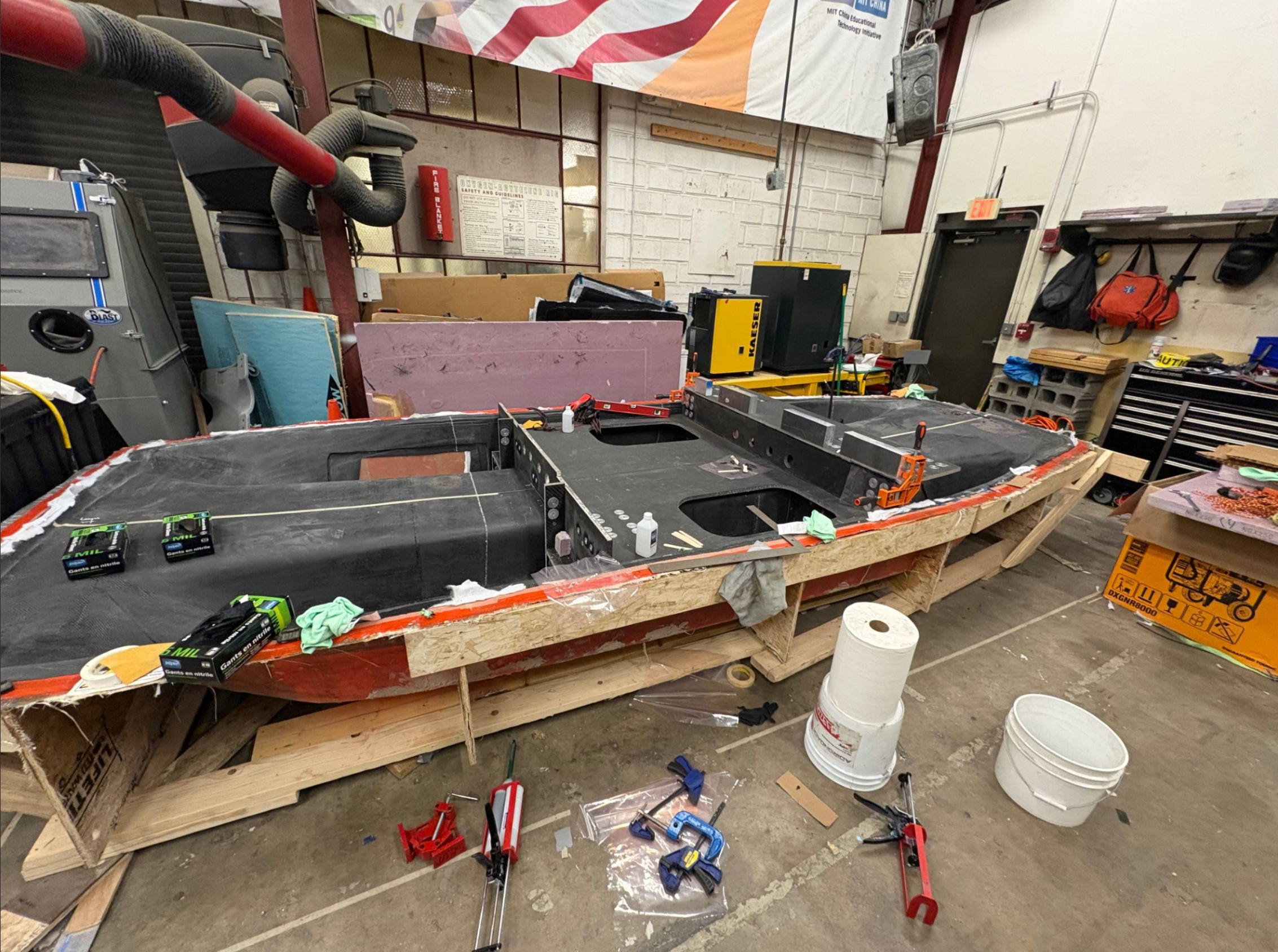
Composite Chassis FEA
Context
When I joined the chassis subteam, the vehicle’s composite chassis had not yet been fully validated against the American Solar Challenge (ASC) front, side, and rear impact load cases. The existing occupant cell also constrained driver legroom enough that many team members could not comfortably fit in the vehicle.
My responsibility was to develop the chassis FEA workflow, evaluate the existing structure, and make the structural and geometric changes needed to satisfy the required impact cases while increasing usable occupant space.
The main structural design and validation work was completed within a one month design cycle. Across roughly 60 simulation iterations spanning the required impact scenarios, I finalized the chassis geometry and reinforcement strategy in time for our Vehicle Design Review submission to American Solar Challenge organization. Manufacturing and vehicle integration continued afterward.
Developing the FEA Workflow
I began the project with no previous experience performing composite FEA, so the first part of the process was focused on developing a simulation workflow that produced consistent and physically reasonable results.
The chassis was a multi-component sandwich structure consisting of composite skins, core materials, bonded joints, and reinforcement panels. I used ANSYS ACP to define composite layups and material properties using data from physical material testing, then built the structural model around the actual construction of the chassis.
A significant part of this work involved understanding how modeling decisions affected the results. This included:
Defining bonded and contact interfaces between chassis components
Selecting appropriate constraints and load application methods for each ASC impact case
Representing composite sandwich construction and local reinforcements in ACP
Using measured material data rather than relying solely on generic material properties
Evaluating composite failure using criteria including Tsai-Wu and core crushing
Refining contact behavior and parameters such as pinball radius when modeling closely spaced or interacting components
Developing a repeatable setup was particularly important because each geometry change needed to be evaluated across multiple impact cases rather than optimized for a single loading condition.
I initially ran into convergence problems using a Lagrange multiplier contact formulation because small CAD intersections between the chassis and aeroshell created unintended initial penetration. I later resolved this by correcting the geometry and switching to an MPC-based bonded contact formulation, which was better suited for our use case and was less computationally expensive.
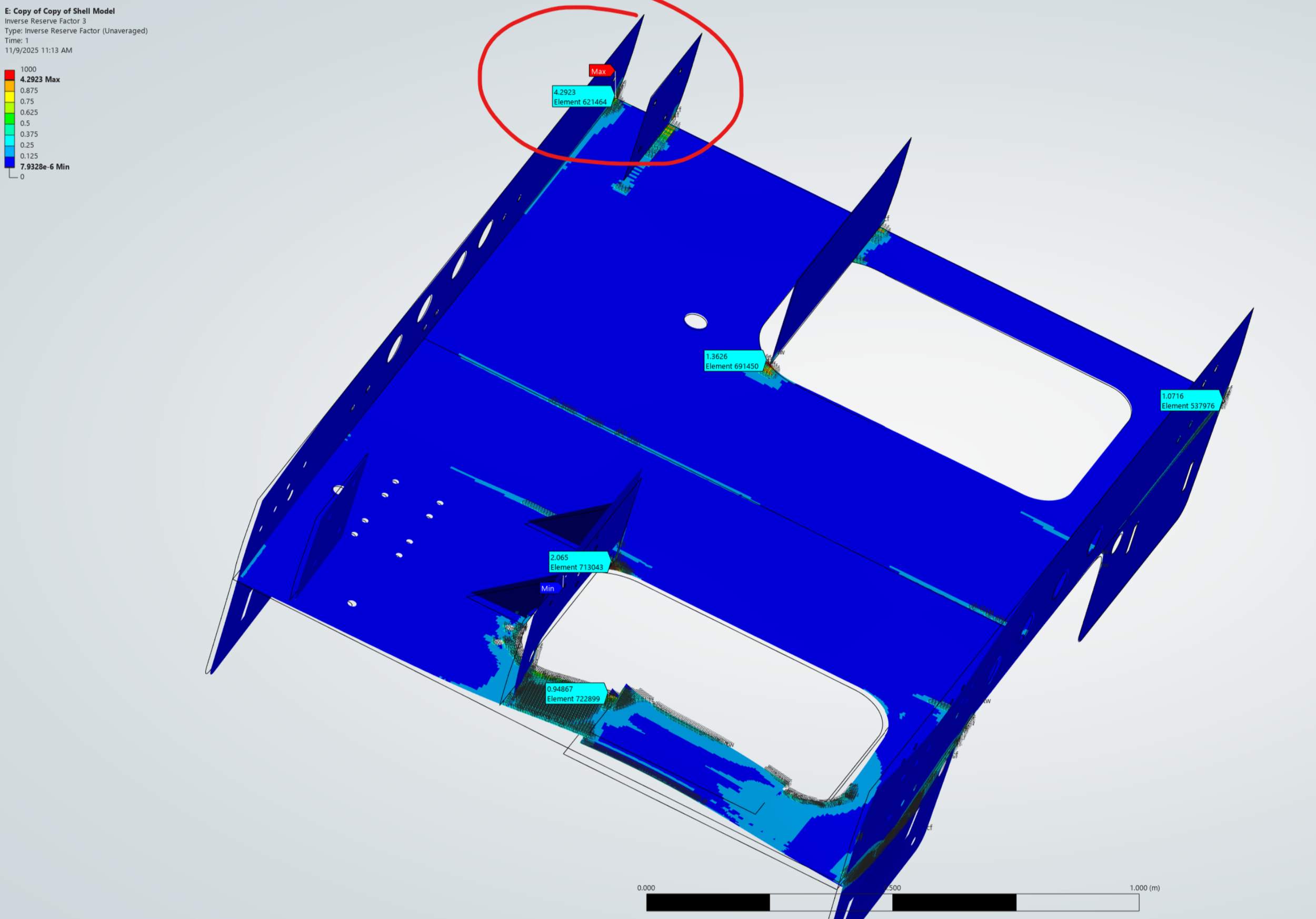
Quickly switched to shell modeling for faster iteration with ~15min solve times
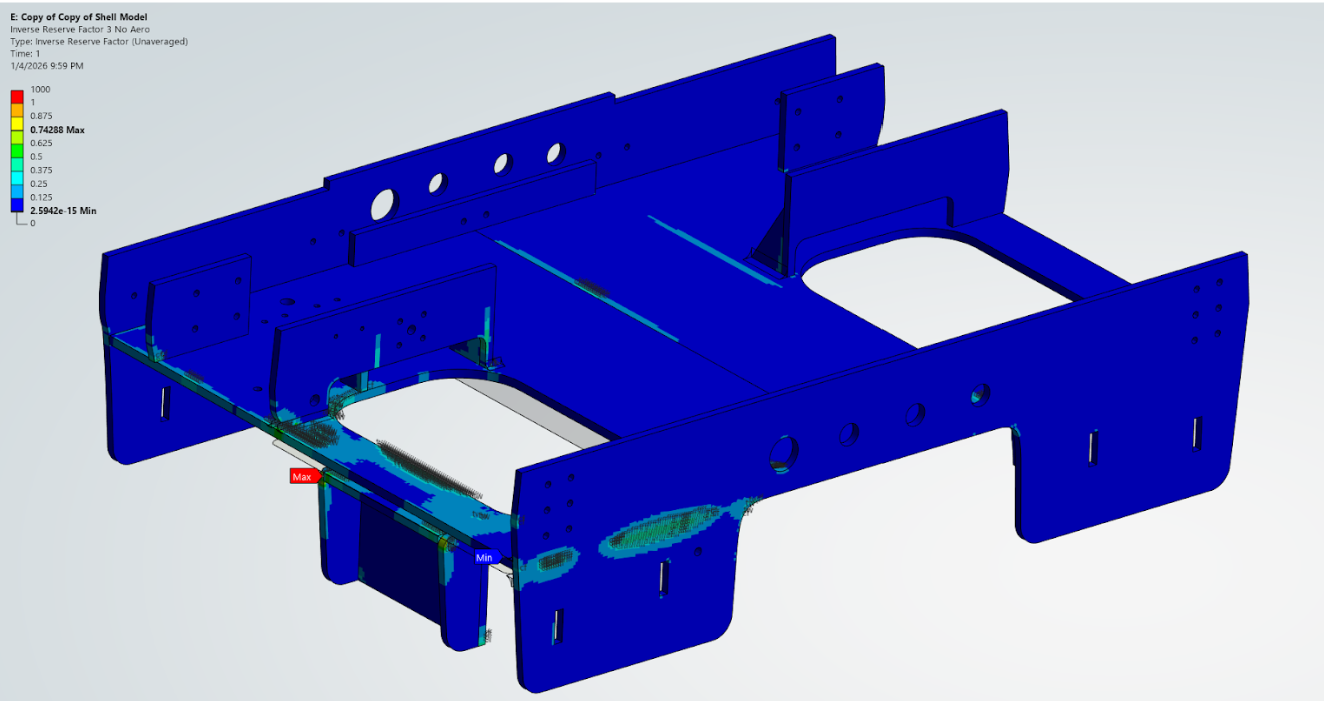
Prior to manufacturing, the final validation runs were completed using a solid model with a refined mesh for a more accurate representation of the composite sandwich
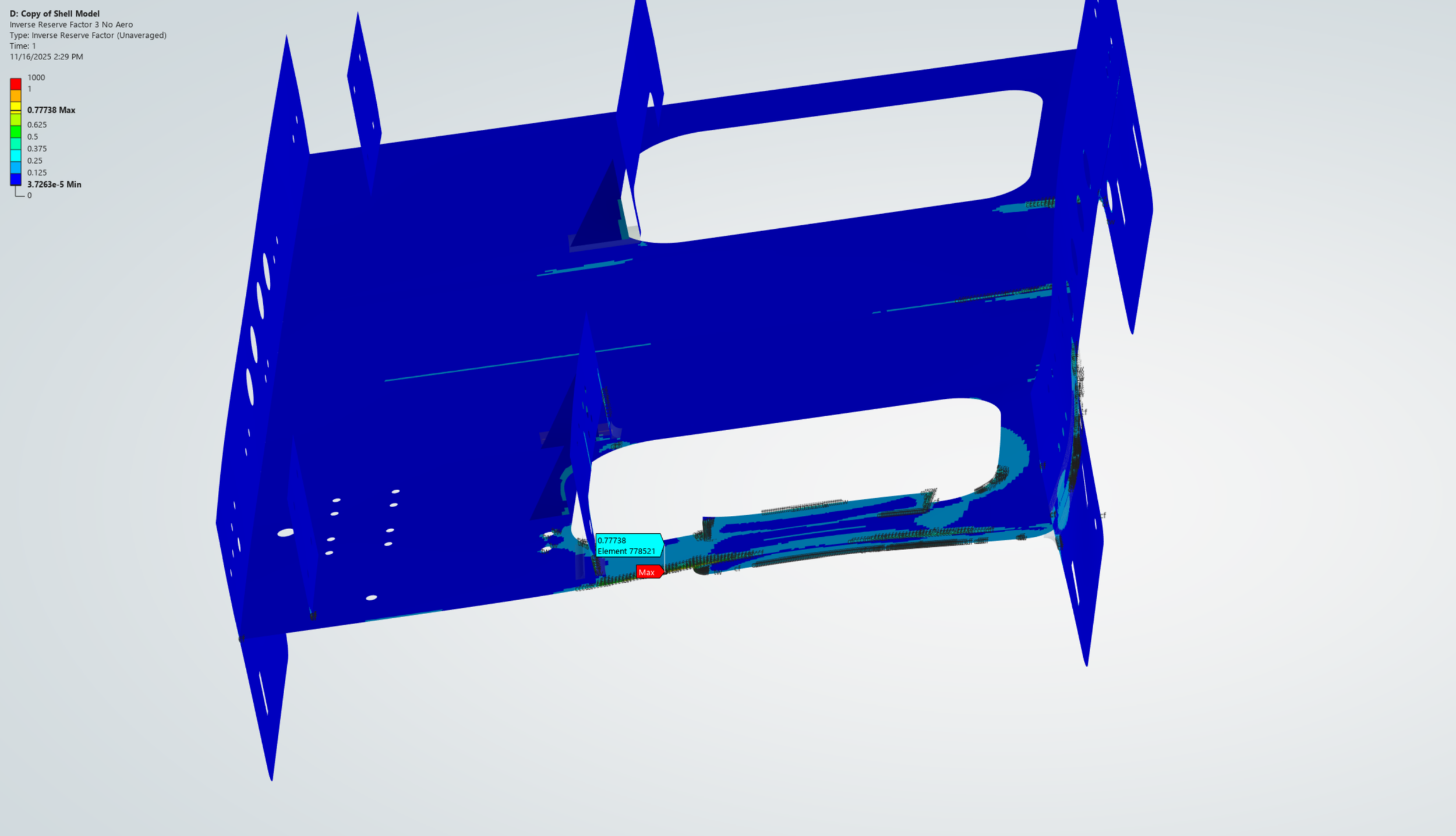
Made improvements through experimenting with different reinforcement geometries and material layups (weave vs unidirectional, solid “Dragon Plate” vs honeycomb sandwich)
Mid-Design Integration Problems
While the chassis panels were already being manufactured, two integration problems surfaced that required substantial changes to the structural model and final design.
Loss of the Primary Aeroshell Bond
The externally manufactured lower aeroshell mold was significantly out of tolerance, leaving a large 5mm gap between the horizontal chassis panel and the aeroshell.
To keep manufacturing moving, the gap was filled with microsphere-thickened epoxy. Because this joint was not considered a qualified structural bond, I couldn’t rely on it to transfer the impact loads assumed by the original design.
This was especially important during side-impact loading, where the original geometry depended on load transfer between the horizontal chassis panel and surrounding structure. I revised the model to remove the structural contribution of this bond and evaluated how the resulting load path changed.
The analysis showed that additional reinforcement was required to transfer these loads without depending on the compromised interface.
Occupant Cutout Redesign
The original occupant opening fit drivers in CAD, but physical mock-up testing revealed that it did not provide enough room for realistic leg movement. This severely limited the number of team members who could drive the vehicle.
Increasing the opening solved the packaging problem but created a structural one. The cutout removed material from an important region of the chassis, reducing bending stiffness and changing the load paths for several side-impact cases. The larger opening also increased local stresses around its perimeter.
Because the main chassis panels were already entering manufacturing, completely redesigning the structure was no longer practical.
Design Response
At this stage, the redesign was constrained by both schedule and available material. Changes needed to work with panels that were already being manufactured and were largely limited to modifying the occupant opening and adding reinforcement using leftover composite material.
I made three main changes:
Extended and reshaped the occupant opening to provide additional legroom and improve driver accommodation
Added local reinforcement around the cutout perimeter to recover stiffness and reduce stress concentrations introduced by the larger opening
Added reinforcement panels that created a direct structural load path between the horizontal chassis panel and surrounding structure without relying on the compromised aeroshell bond
Each change was iterated in FEA and then re-evaluated across the full set of front, side, and rear impact cases. This was important because modifications that improved one load case could shift loads or increase stresses elsewhere in the chassis.
Results
The final chassis design was completed and structurally validated within the one month design window, allowing manufacturing to continue without restarting the primary chassis panels.
The redesign:
Satisfied the required ASC front, side, and rear impact load cases before the Vehicle Design Review deadline
Increased the simulated structural safety margin relative to the previous chassis design
Restored load transfer around the compromised aeroshell interface through dedicated reinforcement
Increased the potential driver pool by more than 2× through the enlarged occupant opening
Allowed chassis manufacturing and vehicle integration to continue without a major redesign of already-produced components
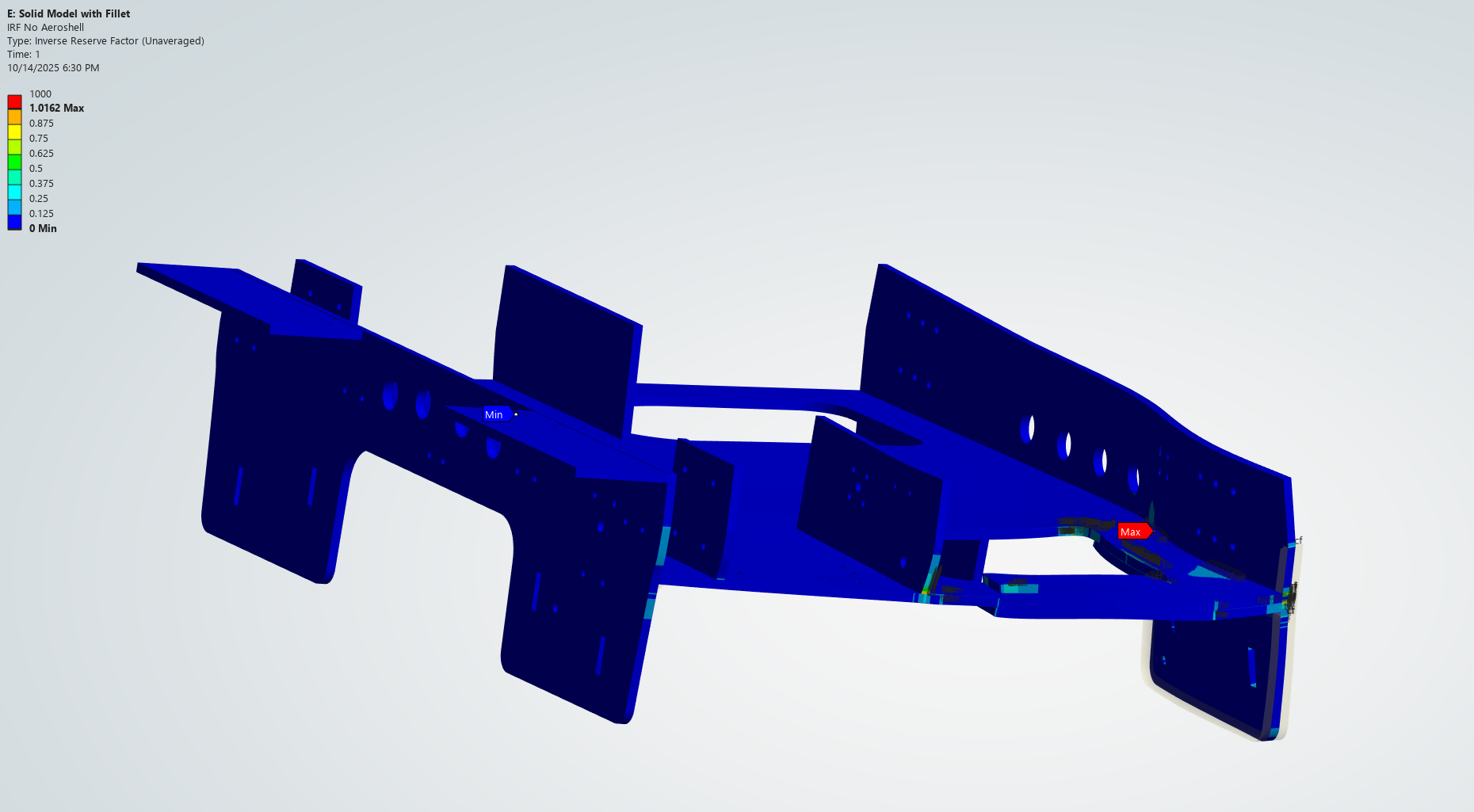
Started with solid models in Ansys - accurate, but required long 90+ min solve times
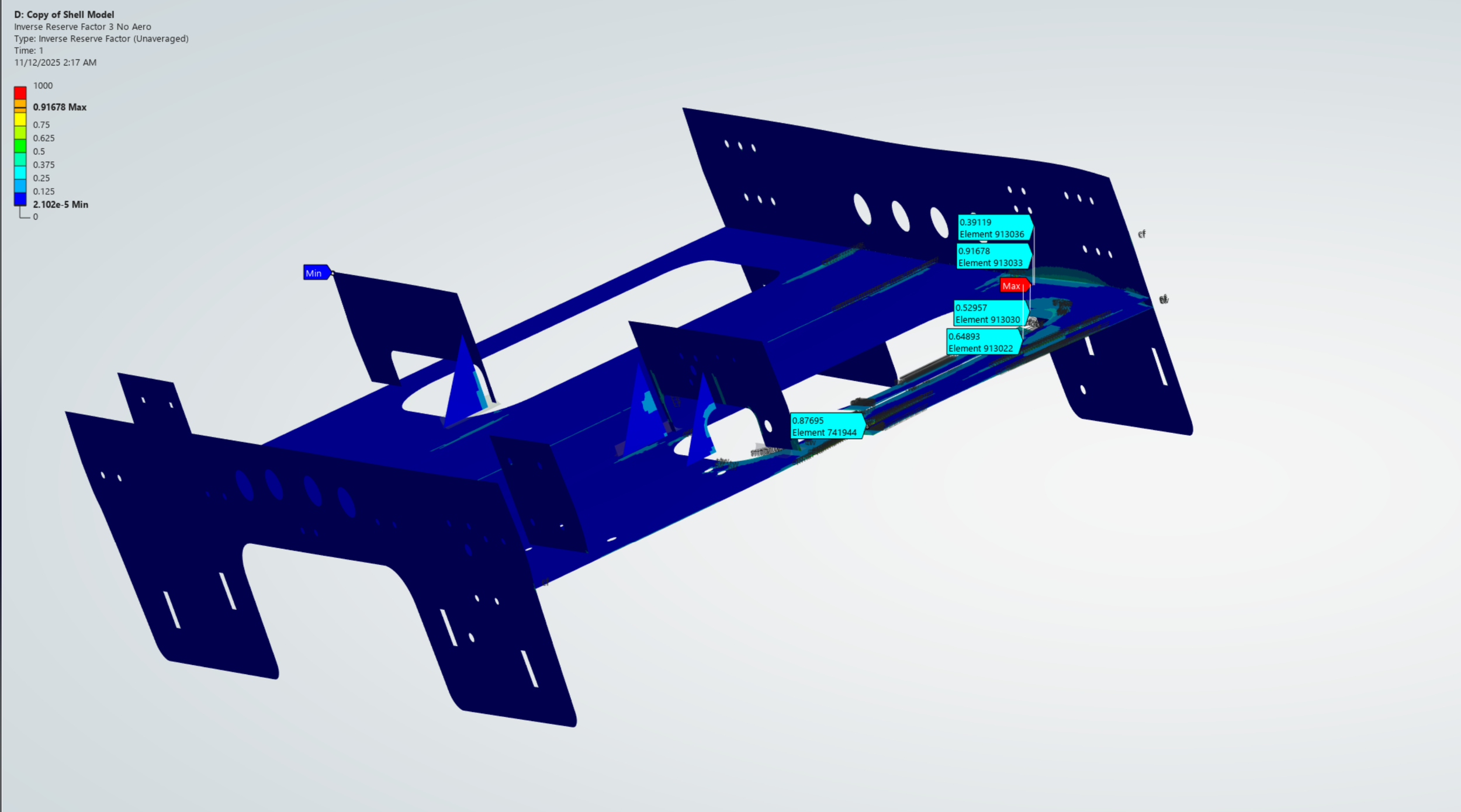
Initial modifications showed poor results
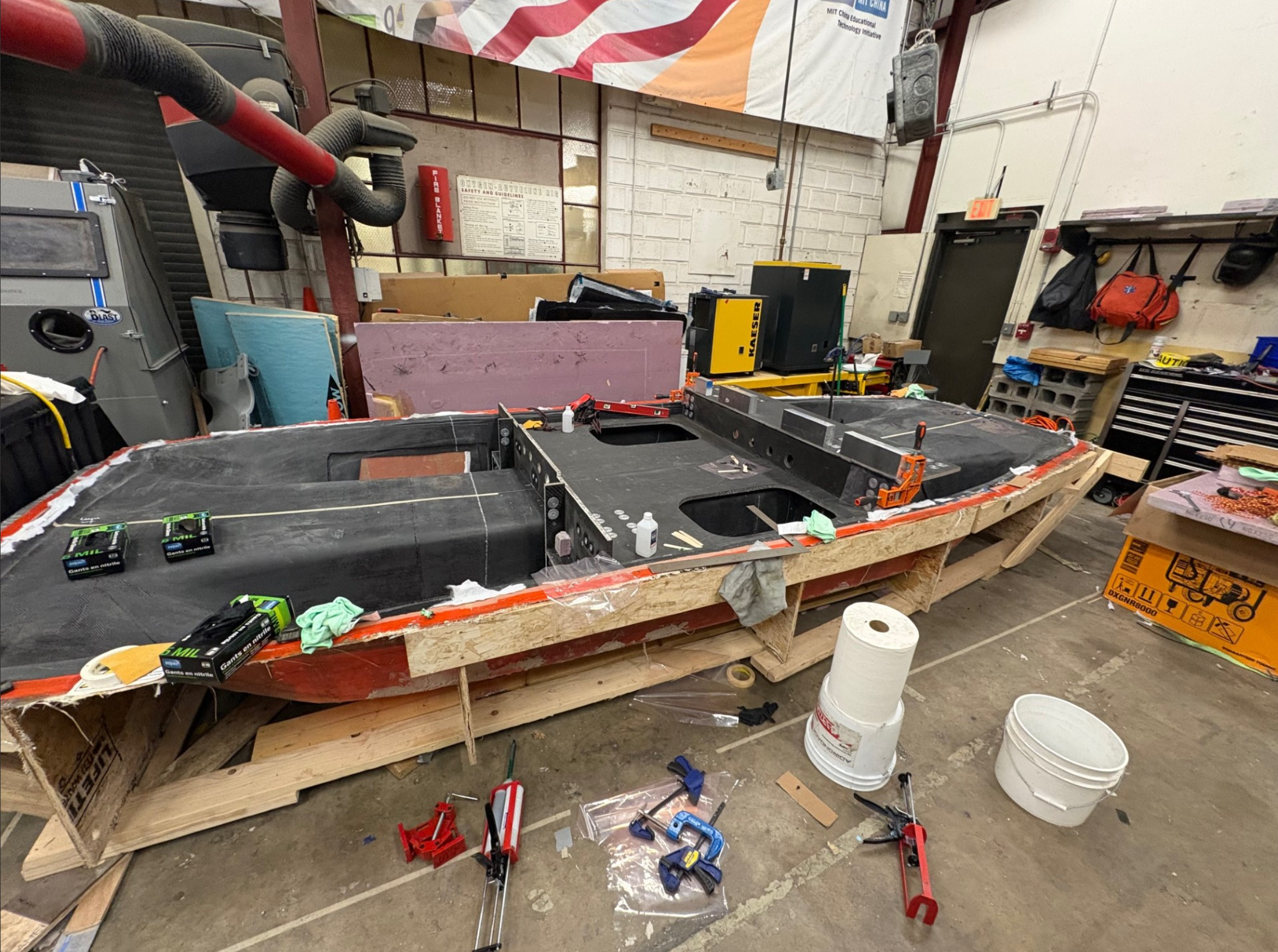
Finalized chassis during assembly
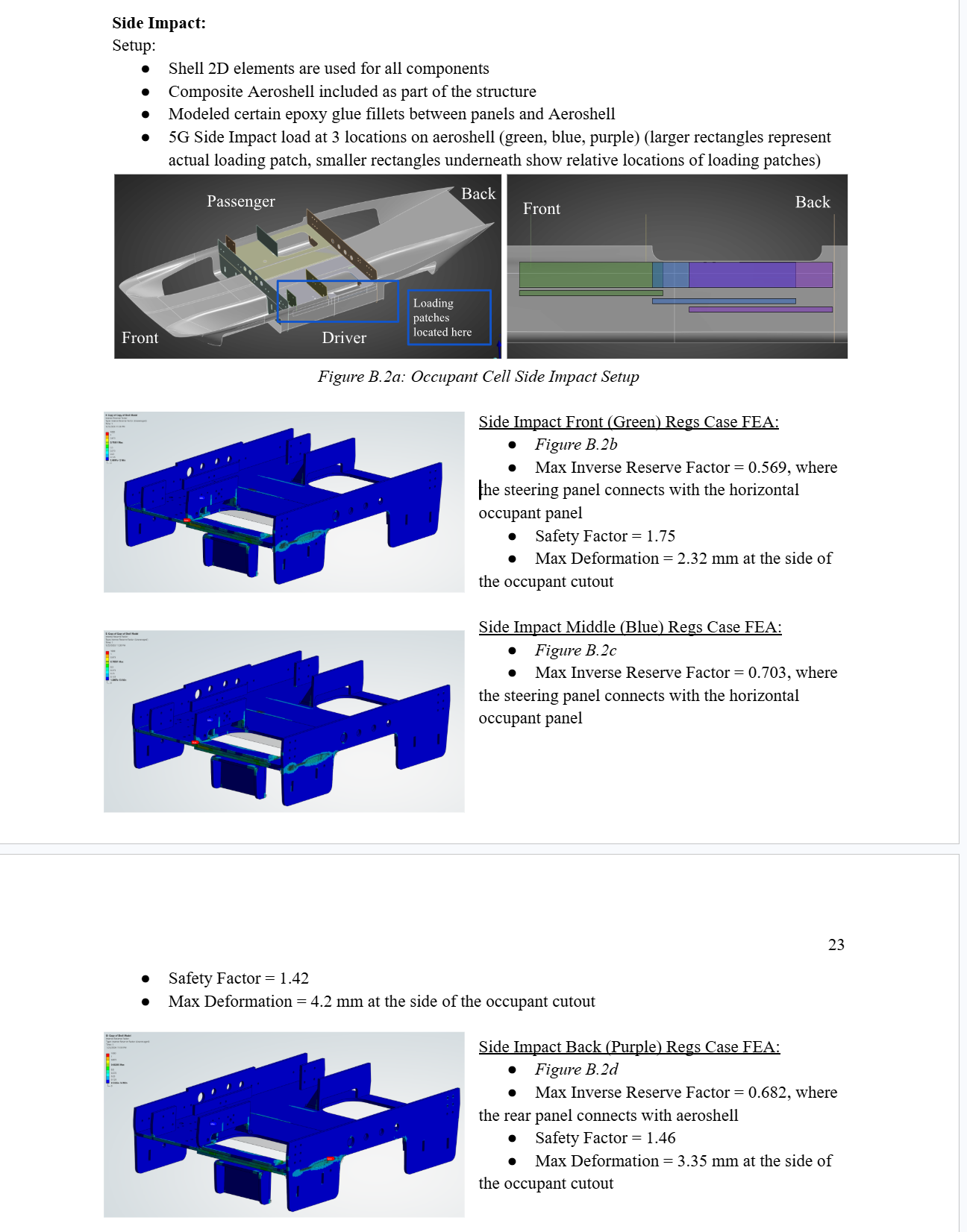
Final results documented in VDR
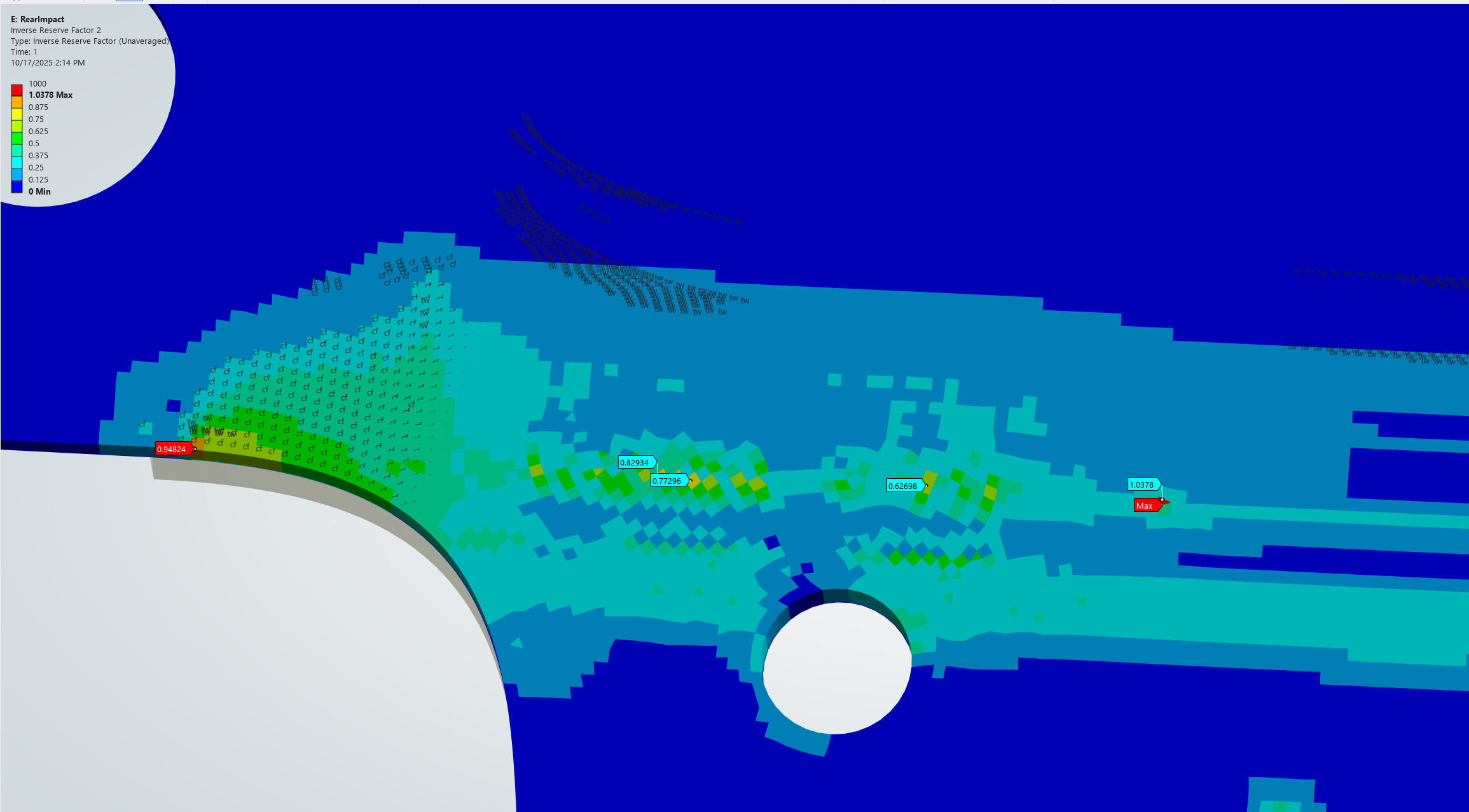
Initially, rear panel, among other areas, consistently showed stress concentrations on the loading patch - needed to add reinforcements + make design changes to address these areas